
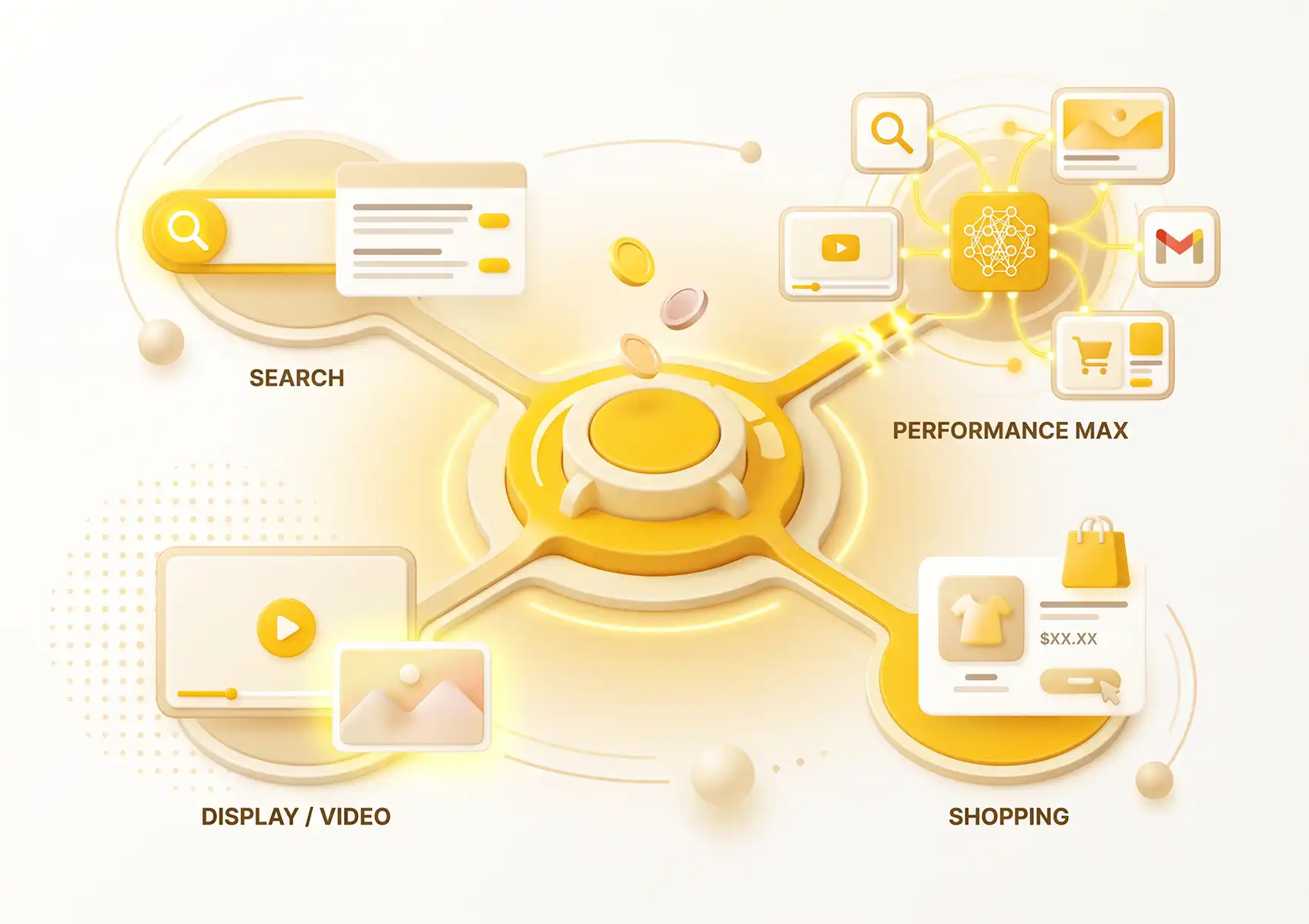
Choosing a campaign type in Google Ads is often rushed, with limited attention to the marketing goals it should support. This leads to spending budget on audiences unlikely to convert.
This decision requires careful consideration, as it determines where your ads are shown, who sees them, and how your budget is allocated across Google’s networks.
This guide explains the main campaign types, the goals each one supports, and the common mistakes that waste budget. The aim is to help you select the right fit for your business from the outset.
Why This Decision Comes Before Keywords and Ad Copy
Keywords, bids, and ad copy are all set within a campaign, so your choice of campaign type defines the boundaries for every decision that follows. For instance, a Search campaign delivers text ads to users searching on Google, while a Video campaign targets YouTube viewers.
Getting this decision wrong can be costly, because paid clicks add up quickly. In WordStream’s 2026 benchmarks, drawn from more than 13,000 search campaigns across 23 industries, the headline figure reads “The average cost per click in Google Ads in 2026 is $5.42” (quoted verbatim, in US dollars). Costs vary widely by country and industry, yet wherever you advertise, every rupiah spent in the wrong kind of campaign could have reached a better audience.
No single campaign type fits every business. Each serves a specific purpose, so the logical starting point is defining your goal.
Start With Your Goal, Then Choose the Type
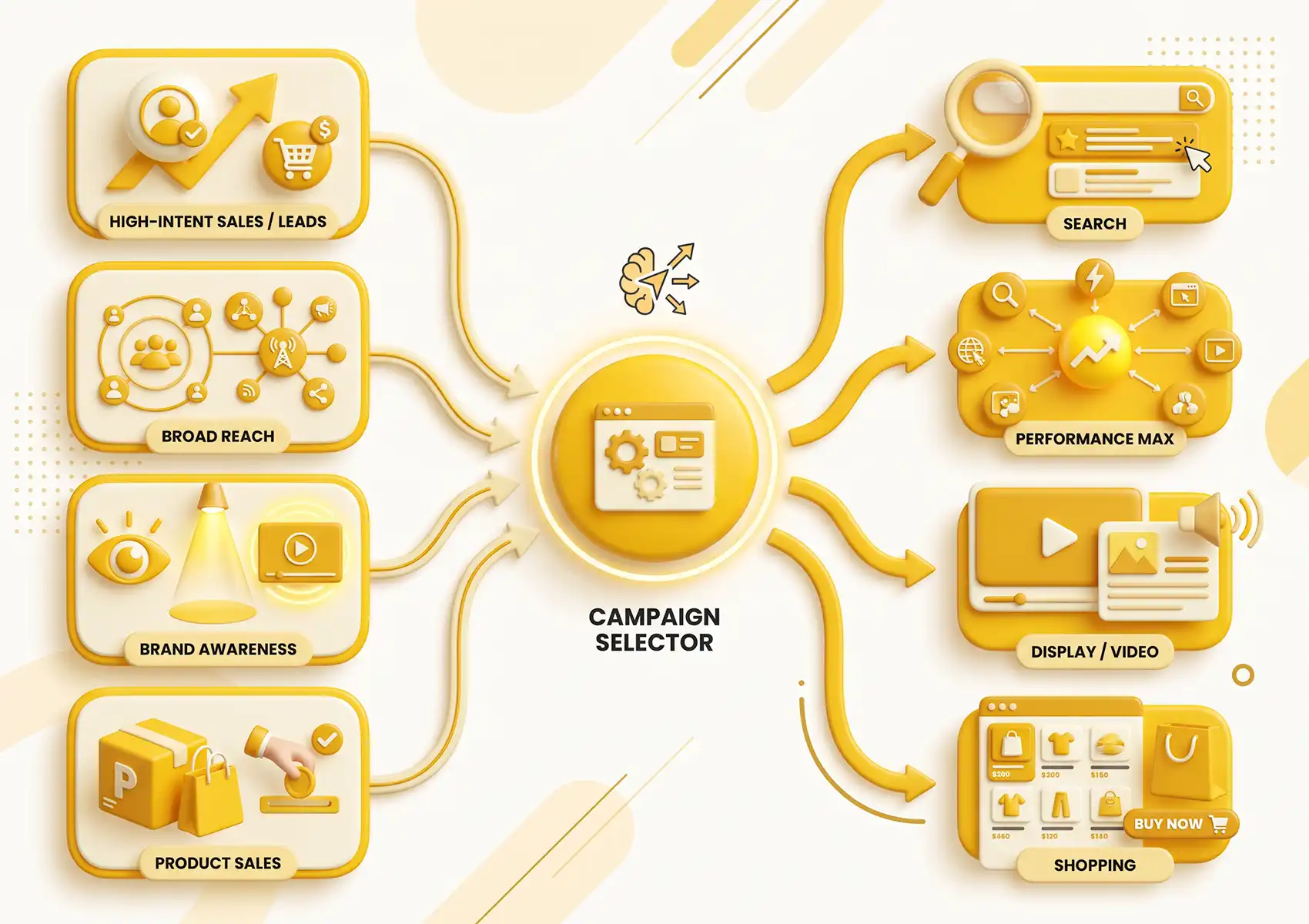
It is more effective to begin with your desired outcome than to choose a campaign type based on appearance. Once you define your goal, identifying the right campaign type in Google Ads becomes straightforward. The table below matches common marketing goals to the most suitable campaign types.
| Marketing Goal | Recommended Type |
| Leads or sales from people already searching | Search |
| Conversions across Google’s channels from one campaign | Performance Max |
| Brand awareness and consideration | Display or Video |
| Online sales of physical products | Shopping, or Performance Max with a product feed |
| Re-engaging past website visitors | Display or Video using your data segments |
Starting from the goal helps you avoid paying. Defining your goal first prevents spending on reach when you need enquiries, or on clicks when your objective is brand awareness. This approach also clarifies reporting, as each campaign is measured against the job it was set up to do.
The Main Types in Google Ads and Who They Suit
Google Ads offers six main campaign types: Search, Performance Max, Display, Video, Shopping, and App. App campaigns are only relevant if you have a mobile app to promote, so the following sections focus on the other five, grouped by their primary use case.
Search Campaigns for People Already Looking
Search campaigns display text ads on Google’s results pages when users search for your products or services, so each click typically reflects strong intent. These campaigns are straightforward to set up and require only ad copy and keywords, without images or video. The range of searches that can trigger your ad depends on keyword match types, which we explain in a separate guide. The limitation is that Search campaigns capture only existing demand and cannot generate interest in products or services users aren’t yet searching for.
Performance Max for Conversions Across Google’s Channels
Performance Max is a goal-driven campaign type that accesses all Google Ads inventory from a single campaign. Google AI manages bids and placements across Search, YouTube, Display, Discover, Gmail, and Maps, which can reveal conversions that are difficult to reach through separate campaigns.
The trade-off is control, since you have less say over where ads appear and less reporting detail than a standard Search campaign provides. It also relies heavily on accurate conversion tracking, so set that up properly before you launch.
Display and Video for Awareness and Consideration
Display campaigns serve visual ads across millions of websites, apps, and Google-owned properties. Video campaigns run ads on YouTube and Google video partner sites. Both are most effective in the early stages of the buying journey, when users are becoming familiar with a brand, and are typically measured by reach and engagement. However, both can be configured to drive sales or leads, and Video campaigns offer a dedicated ‘Drive conversions’ subtype for action-oriented objectives.
Shopping Campaigns for Product Retailers
Shopping campaigns display product listings on search results and the Google Shopping tab. To use Shopping, you need a Merchant Centre account with your product inventory uploaded. You can use the same product feed in Performance Max to extend your reach across more Google channels. If your business sells services such as spa treatments, classes, or consultations, Shopping is not suitable, and Search campaigns are generally a better starting point.
Match the Choice to Your Budget
Your budget also influences which campaign type is appropriate. Smart Bidding requires enough conversion data, and splitting a small budget across multiple campaigns often leaves too little data for effective optimisation.
Starting narrow is simpler to manage and to measure. Placing a modest monthly test budget, such as Rp1.500.000, in a single Search campaign keeps your spend focused and makes the early results clearer. Treat that first month as a learning period, not a final verdict.
Once your initial campaign generates leads or sales at an acceptable cost, you can expand into Performance Max or Display, using actual results to inform your next steps.
Common Mistakes That Waste Ad Spend
A few common mistakes can waste budget, regardless of ad quality. Avoiding these errors protects your spend and the data you need to improve performance.
- Launching Performance Max before conversion tracking is in place, which leaves Google’s AI with nothing reliable to optimise towards.
- Splitting a small budget across several campaigns at once, so none gather enough data to perform well.
- Judging a Display or Video awareness campaign on direct sales, when it was set up to build reach rather than drive immediate purchases.
- Choosing a type before defining the marketing goals behind it, leaving the whole account without clear direction.
Build a More Effective Google Ads Strategy With Gaia
If you want expert input before investing, our online advertising services can help you plan your next steps. Start with a conversation about which campaign type matches your goals and budget. Visit Gaiada.com to get in touch.


