

Keyword stuffing is one of the oldest mistakes in SEO, and it is still happening in content published today. Not always in the obvious way, where the same phrase repeats six times in a paragraph, but in subtler ways: the alt text crammed with keyword variants, the meta description that reads like a keyword list, the FAQ section where every answer opens with the target phrase. The damage is the same regardless of where it occurs. Google treats it as a spam signal and ranks the page accordingly.
The other failure mode is less discussed but equally damaging. Brands so afraid of over-optimising that they barely use their target keyword at all produce content that is readable but invisible. On-page keyword optimisation is not about frequency. It is about placement, context, and knowing exactly where the signal needs to land and where it needs to stay out of the way.
What Keyword Stuffing Actually Is
Before fixing keyword stuffing, you need to know precisely what it is and what it is not. The definition matters because much of what gets flagged as stuffing is actually just clumsy writing, and much of the actual stuffing goes undetected because it is hidden in places no one thinks to check.
Google’s Official Definition of Keyword Stuffing
According to Google’s spam policies, keyword stuffing refers to “the practice of filling a web page with keywords or numbers in an attempt to manipulate rankings in Google Search results. Often these keywords appear in a list or group, unnaturally or out of context”. It is a direct violation of Google’s spam policies and can result in a page or an entire site being ranked lower or removed from search results entirely.
The Difference Between Keyword Stuffing and Keyword Optimisation
Keyword optimisation places the right term in the right location to signal relevance to Google. Keyword stuffing repeats a term beyond the point of relevance in an attempt to force a ranking signal. The distinction is intent and readability. If reading a sentence aloud feels unnatural, the keyword has been forced in. If it reads as though a person wrote it for another person to read, it is optimised.
Keyword Stuffing Examples and What They Look Like in Practice
Two widely cited examples illustrate what keyword stuffing looks like in practice.
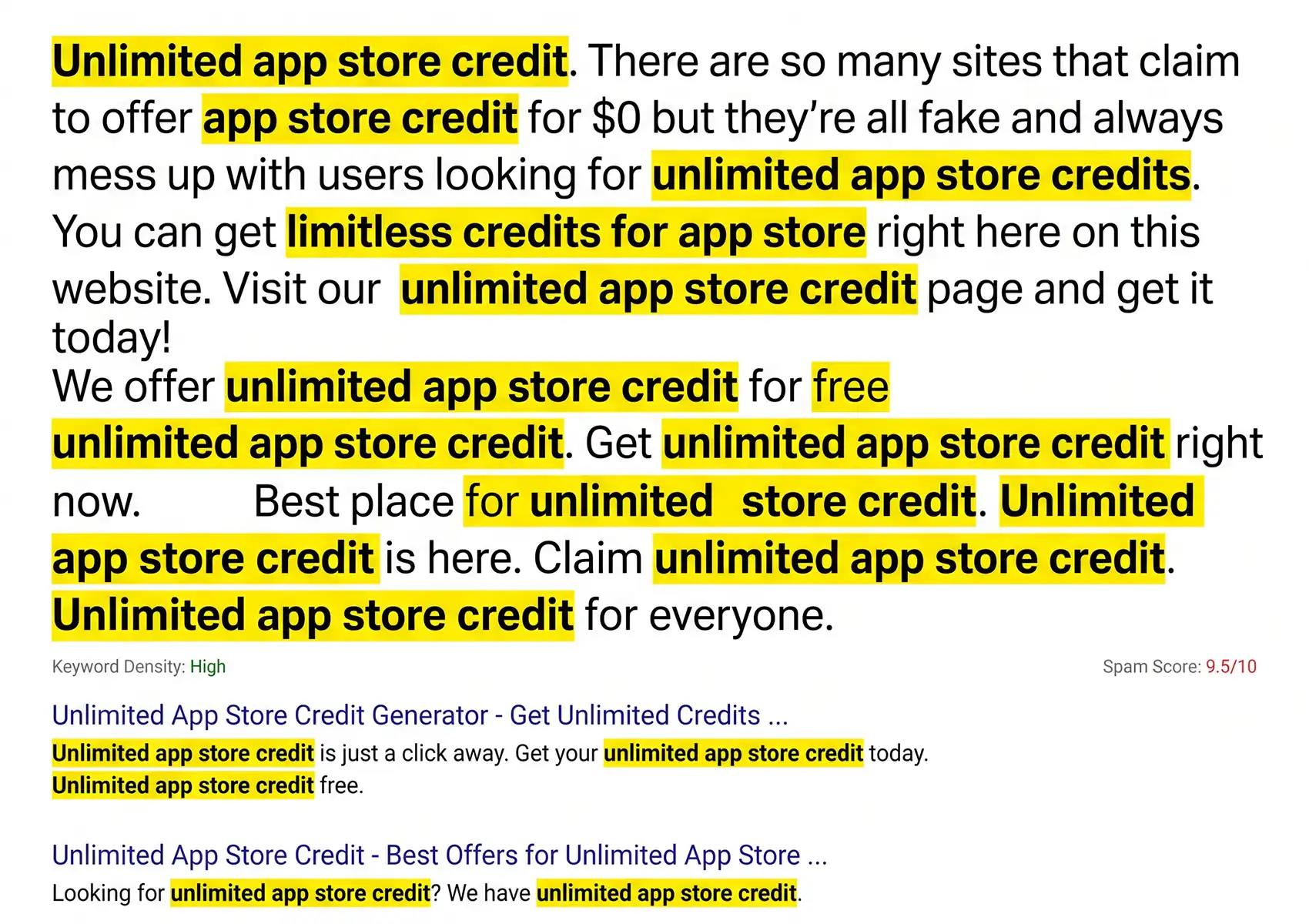
Google’s spam policies documentation provides this verbatim example: “Unlimited app store credit. There are so many sites that claim to offer app store credit for $0, but they’re all fake and always mess up with users looking for unlimited app store credits. You can get limitless credits for the app store right here on this website.”
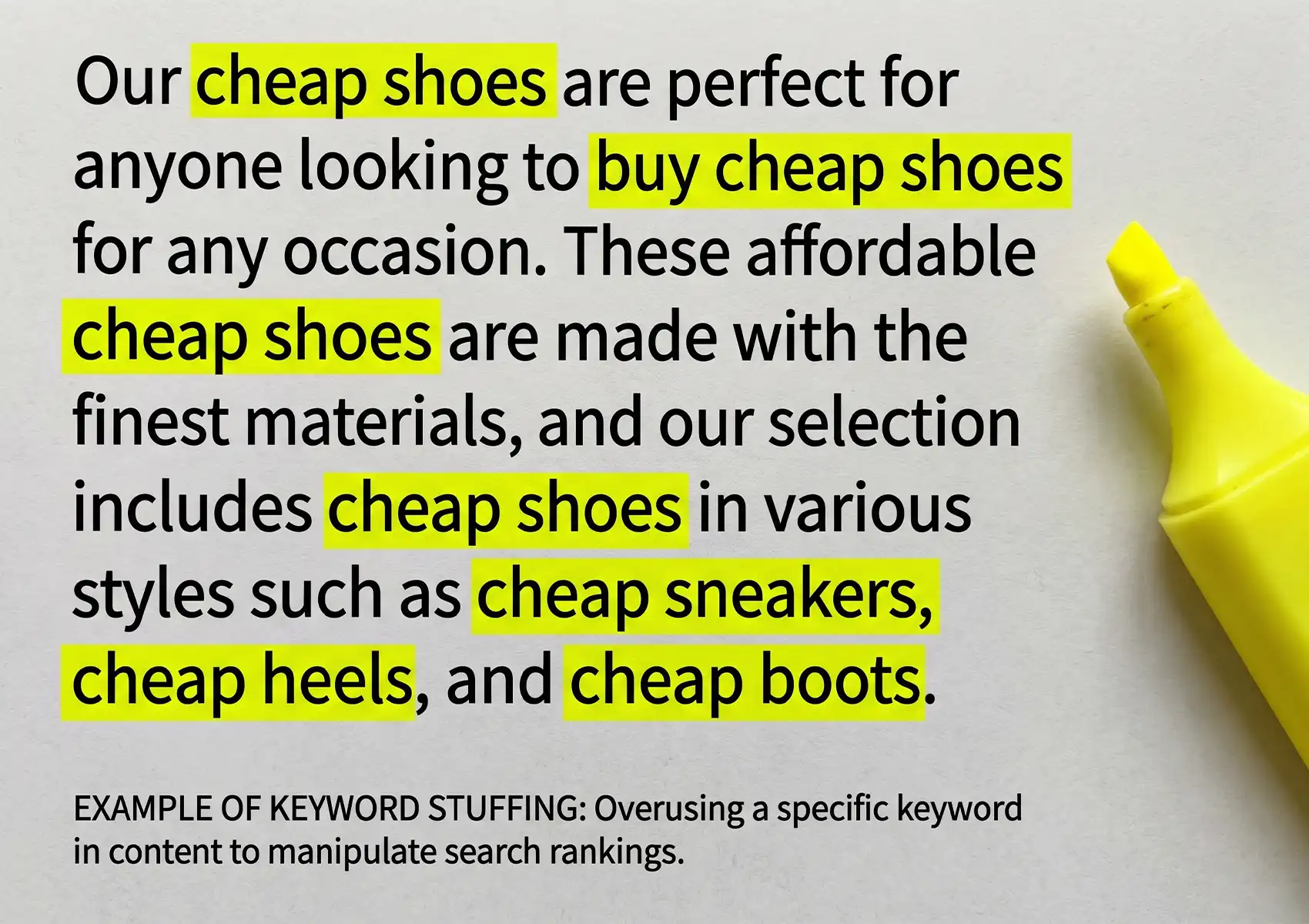
Semrush provides this one: “Our cheap shoes are perfect for anyone looking to buy cheap shoes for any occasion. These affordable, cheap shoes are made with the finest materials.”
Both are immediately recognisable because they prioritise the keyword over the reader. The phrase is not there to inform. It is there to signal, and Google’s algorithms are built to detect exactly that pattern.
Where Keyword Stuffing Actually Hides
Stuffing is not always visible in the body copy. In our content audits at Gaia Digital Agency, the most commonly overlooked stuffing occurs in fields that sit outside the main text but are still fully readable by Google’s crawlers.
Body Copy and the Repetition Pattern to Watch For
The clearest signal of body copy stuffing is a keyword that appears in every paragraph, regardless of whether it adds meaning. If removing a keyword from a sentence leaves it intact and clearer, it should be removed.
Title Tags, Meta Descriptions, and H1s Explained
Overloading title tags with keyword variants, writing meta descriptions that read as keyword lists, and using an H1 that forces multiple keyword phrases are all forms of stuffing. Each of these fields should contain the primary keyword once, naturally, and nothing more.
Image Alt Text and Internal Link Anchor Text
Alt text stuffing looks like this: “best running shoes running shoes buy running shoes.” Google explicitly flags this as spam, and it damages both accessibility and rankings. An internal link anchor text crammed with keywords is equally problematic. Both fields should describe content accurately, not serve as keyword insertion points.
Schema Markup, FAQs, and AI-Generated Content
Schema markup, FAQ sections, and AI-generated content are three areas where keyword stuffing is increasingly common and increasingly detected. Google’s spam systems now evaluate language patterns across an entire page, not just the body text. Repeating the same phrase in every FAQ answer, or generating content that mechanically inserts a keyword into every other sentence, triggers the same spam signal as traditional stuffing.
Where Keywords Should Actually Appear on a Page
Keyword placement is not about saturation. It is about putting the signal in the locations Google weights most heavily and then writing naturally everywhere else.
Title Tag and H1
The primary keyword belongs in both the title tag and the H1. These are the two highest-weighted on-page signals available, and each should contain the keyword once, preferably towards the beginning of the tag or heading.
First Paragraph and URL
Including the primary keyword in the first 100 words of the page and in the URL slug reinforces the topical signal established by the title and H1. Neither requires exact-match phrasing. A natural inclusion within the first paragraph is sufficient.
Subheadings, Body Copy, and Image Alt Text
Use the primary keyword in one or two subheadings where it fits naturally. In body copy, aim for one or two appearances per 500 words. In image alt text, describe the image accurately and include the keyword only where it genuinely reflects what the image shows.
Meta Description
The meta description does not directly influence rankings, but it does influence click-through rate. Include the primary keyword once, naturally, within a description written for the human reader rather than the search engine.
Keyword Placement Strategy Beyond the Primary Keyword
Relying on a single keyword phrase repeated throughout a page is both a stuffing risk and a missed opportunity. The strongest on-page content uses a range of related terms that signal topical depth rather than mechanical repetition.
Using Semantic Variants and LSI Terms Naturally
LSI (latent semantic indexing) terms are semantically related phrases that help Google understand the full context of a page without requiring the exact primary keyword to repeat. A page about keyword stuffing might naturally include terms such as “over-optimisation,” “keyword density,” “spam policies,” and “on-page SEO” without keyword stuffing.
Stop Words and Making Keyword Phrases Read Naturally
Stop words are common words that search engines largely ignore during indexing, but that make keyword phrases read naturally in copy. Writing “the best approach to keyword placement” rather than “best keyword placement approach” preserves the keyword signal whilst producing a sentence a reader would actually write. This is a straightforward fix for awkward keyword insertion that many content writers overlook.
Supporting Keywords and Where They Belong
Supporting keywords should appear in subheadings and body paragraphs where they are genuinely relevant to the point being made. Each supporting keyword should appear once or twice at most. If a supporting keyword cannot be placed naturally, it signals that the content does not yet cover that topic with sufficient depth.
Topic Depth as a Replacement for Repetition
Google’s algorithms now evaluate how well a page covers a topic, not just how often a keyword appears. A page that comprehensively addresses the subject, including definitions, examples, fixes, and related concepts, signals expertise far more effectively than one that repeats a single phrase. Depth replaces repetition as the primary keyword strategy.
Optimise Your Content the Right Way With Gaia Digital Agency
Keyword stuffing and on-page keyword optimisation are two sides of the same problem, and striking the right balance is one of the most consistently underestimated factors in organic performance. At Gaia Digital Agency, we audit and optimise on-page content for brands across Bali, South-East Asia, and international markets, identifying both over-optimised and under-optimised pages and implementing a structured placement strategy that compounds over time. No keyword lists, no density formulas, just content that reads well, signals correctly, and ranks.
Let’s start with a conversation about what your current content is doing and what it should be doing instead.


